Moving Beyond Tradition
From grand cathedrals to simple country chapels, the ritual of water baptism is one of the most recognizable practices in Christianity. It's also a very controversial topic among churches. It's so deeply ingrained in our minds that to question it feels like touching a sacred cow. But does familiarity blind us to the tradition and meaning?
While the Bible is our sole and ultimate authority, we can create confusion if we fail to "rightly divide the word of truth." This can cause sincere believers to embrace traditions that are no longer part of God’s program for today. Making this distinction isn't just an academic exercise. It is foundational to grasping the freedom and spiritual reality we have in Christ, unburdened by the rituals of a program God has since superseded.
The truth is, water baptism was a valid and commanded practice for the nation of Israel under its prophetic program. However, it is not the required ordinance for the Church, the Body of Christ, in this present dispensation of grace. The "one baptism" for believers today is not a water ritual performed by man but a profound spiritual reality accomplished by God. This truth, like so many others, was revealed through the unique ministry of the Apostle Paul, the apostle to the Gentiles. Continuing to practice water baptism often shows a misunderstanding of Paul's distinct teachings and can lead believers to read water into texts that are spiritually "dry."
The Foundation: Israel's Required Ritual
Before we can understand why this practice isn't for today, we have to grasp why it was so significant in the first place. For the nation of Israel, water baptism wasn't a choice; it was a required ordinance tied to their national destiny. When the Apostle Peter commanded the "men of Israel" to "Repent, and be baptized... for the remission of sins" (Acts 2:38), he wasn't offering a helpful suggestion. He was laying out a divine requirement.
This practice was deeply rooted in Israel's prophetic hope, echoing Old Testament purification rituals and prophecies like Ezekiel 36, specifically Ezekiel 36:25-27. It was a necessary cleansing to "make their path straight" for their Messiah (Mark 1:3) and prepare them to become a "kingdom of priests, and an holy nation" in a future time period (Exodus 19:5-6). For them, repentance and water baptism were the package deal for their sins to be forgiven as they awaited their promised kingdom.
This is the historical foundation that most churches build upon today. They continue the practice as an act of obedience, often citing commands like the Great Commission. They view it as an important outward symbol of an inward faith, even if they separate the act itself from salvation. But in doing so, are they unintentionally carrying forward a ritual from a program that has since been fulfilled and superseded?
Not All Baptisms Are Wet
To understand the role of baptism today, we must first grasp a crucial biblical truth: the word "baptism" does not always refer to water. The Bible speaks of multiple, distinct baptisms, each with a different purpose and method. Assuming every mention of baptism involves getting wet is a foundational error that clouds clear doctrine. A careful look at Scripture reveals several "dry" baptisms.
- Baptism Unto Moses: In 1 Corinthians 10:1-2, Paul explains that the forefathers of Israel "were all baptized unto Moses in the cloud and in the sea." This was a spiritual, "dry" baptism. As they passed through the Red Sea, with walls of water on each side and the cloud of God's presence overhead, the entire nation was supernaturally identified with their leader, Moses. This corporate identification is fundamentally different from our individual baptism into the Body of Christ.
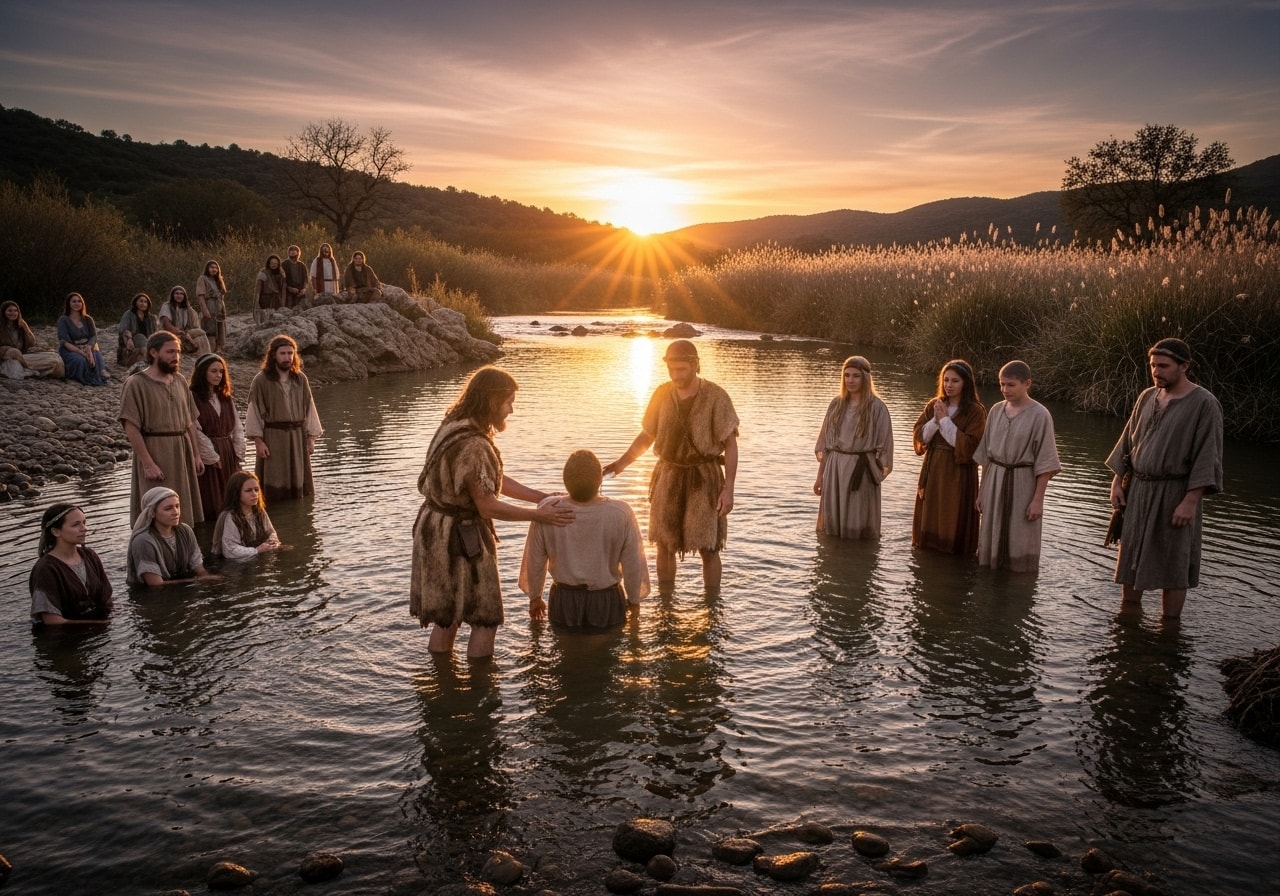
- John's Baptism of Repentance: This is the water baptism most of us know from the Gospels. John the Baptist came to "preach the baptism of repentance for the remission of sins" specifically to Israel (Mark 1:4-5). This ritual was a public confession of sin, preparing the Jewish people for their coming Messiah and His earthly kingdom. It was a national cleansing for a national purpose.
- Baptism with the Holy Ghost: John himself distinguished his water baptism from a more powerful one to come. He declared that the Messiah "shall baptize you with the Holy Ghost" (Matthew 3:11). This was a promise to the faithful remnant of Israel, a supernatural immersion into the power of the Spirit, fulfilled at Pentecost in Acts. This empowerment for Israel's kingdom is distinct from the universal placement of every believer into the heavenly Body of Christ today.
- Christ's Baptism of Suffering: Jesus used the term "baptism" to describe something that had nothing to do with water. He asked James and John, "Are ye able...to be baptized with the baptism that I am baptized with?" (Matthew 20:22). He was referring to the immense suffering and overwhelming agony of His death on the cross. Biblically, "baptism" can signify an immersion into an experience, a principle vital to understanding the Spirit's work in 1 Corinthians 12:13.
Since multiple baptisms exist in Scripture, we must place water baptism within its precise dispensational context: Israel's kingdom program.
The Context of Water Baptism
Once we see that not all baptisms are wet, we can see that water baptism was directly and exclusively tied to the prophetic program for the nation of Israel. When we read commands for water baptism in their proper context, it becomes clear they were given to Israel and for Israel's purposes, not for the Church, the Body of Christ.
In Acts 2:38, after his Pentecost sermon, the Apostle Peter commanded the "men of Israel" to "Repent, and be baptized every one of you in the name of Jesus Christ for the remission of sins." This was a direct response to their national sin of crucifying their Messiah. For them, water baptism was the outward sign of repentance and the path to forgiveness under their kingdom program.
A powerful proof of this distinction appears in Acts 8:15-16. Here, Samaritans believed the preaching about the kingdom of God and were baptized in water. Yet the text explicitly states the Holy Ghost "was fallen upon none of them." They were water baptized but had not received the Spirit. This scenario is an impossibility for a member of the Body of Christ today. In this dispensation of grace, every believer receives the Holy Spirit at the moment of faith. The fact that these believers had one without the other proves they were operating under a different program with different rules.
In our dispensation, the forgiveness of sins is tied to the "preaching of the cross," not a water ritual. Paul, through the mystery revealed to him, teaches that we obtain forgiveness solely through faith in the shed blood of Jesus Christ. As he writes in Ephesians 1:7, "In whom we have redemption through his blood, the forgiveness of sins, according to the riches of his grace." The work is finished. Our forgiveness is a present reality, not something obtained through a ceremony.
The "One Baptism" for the Body of Christ
While water baptism was integral to Israel's program, the Apostle Paul reveals a different, singular baptism for the Church. This baptism is not a ritual performed by man but a supernatural, invisible work of God the Holy Spirit at the very moment of salvation.
In his doctrinal masterpiece to the Ephesians, Paul makes a definitive statement. For the Church, there is "one baptism" (Ephesians 4:5). In an era when multiple baptisms were still in operation (as seen in Acts), this declaration of singularity is profound. It clarifies that for the Body of Christ, all other baptisms have been superseded by one.
There is one body, and one Spirit, even as ye are called in one hope of your calling; One Lord, one faith, one baptism...
Ephesians 4:4-5
So what is this one baptism? Paul defines it in 1 Corinthians 12:13: "For by one Spirit are we all baptized into one body." This is the spiritual reality that forms the Church. It is the invisible act of the Holy Spirit taking a believing sinner and placing them, or immersing them, into the spiritual organism called the Body of Christ. This is a "dry," non-ritualistic, supernatural event that establishes our perfect and permanent union with Christ.
Many mistakenly point to Romans 6:3-4 as a description of water baptism, but a careful reading shows this is not the case. The passage says, "Know ye not, that so many of us as were baptized into Jesus Christ were baptized into his death?" This describes our spiritual identification with Christ's death, burial, and resurrection, not a physical reenactment in a baptistry. It's a reality accomplished by the Holy Spirit, where our old man is crucified with Christ, and we are raised to walk in newness of life. This is the basis of our identity, not a ceremony that pictures it.
Paul's Ministry: An Apostle Not Sent to Baptize
Perhaps the most direct evidence comes from the Apostle Paul himself. As the apostle to the Gentiles, the one to whom the doctrines of the dispensation of grace were revealed, his practice provides the definitive pattern for the Church today.
In 1 Corinthians 1:14-17, Paul makes his position on water baptism crystal clear. He addresses the divisions in the Corinthian church, where factions were identifying with different leaders.
- He explicitly thanks God that he had baptized only a very small number of them (1 Corinthians 1:14). This would be a bizarre thing to be thankful for if baptism were a crucial ordinance for the Church.
- He saw that water baptism had become a source of carnal division, with people glorying in the man who baptized them rather than in Christ (1 Corinthians 1:15).
- Most powerfully, he draws a sharp line between his divine commission and the act of baptizing: "For Christ sent me not to baptize, but to preach the gospel" (1 Corinthians 1:17).
For Christ sent me not to baptize, but to preach the gospel: not with wisdom of words, lest the cross of Christ should be made of none effect.
1 Corinthians 1:17
Paul saw his primary mission and water baptism as two separate activities, and only one was his mandate from the risen Lord. This stark separation is a direct outworking of the mystery revealed to him. The gospel for today, Christ's death for our sins and resurrection for our justification, is a complete and finished work. Tying it to a water ritual from Israel's prophetic program would diminish the all-sufficiency of the cross, a compromise Paul refused to make.
If water baptism were essential for salvation, church membership, or obedience in this age, it is inconceivable that our apostle would relegate it to such a non-essential status. He would not thank God for doing it so rarely or state it wasn't part of his commission. His testimony stands as a clear refutation of water baptism's role in the Body of Christ.
But What About...? Answering Common Objections
Even with this clear evidence, some objections persist. Let's address them head-on.
Objection 1: "Water baptism is just a symbol, so what's the big deal?"
Our critics often begin by agreeing with us. They say, "Mid-Acts claim we don't need water to be saved, but no one was ever saved eternally by water anyway!" They even quote 1 Peter 3:21, which says baptism is "not the putting away of the filth of the flesh, but the answer of a good conscience toward God."
This is precisely our point! They are unwittingly arguing for our position. Water baptism was never the only reqirement to secure eternal salvation; it was a physical ritual for Israel's national program. For them, it was a required public act of identification with their Messiah for the "remission of sins" needed to enter the promised earthly Kingdom. Peter’s command was explicit: "Ye men of Israel... Repent, and be baptized... for the remission of sins" (Acts 2:22, 38). If water baptism is not for salvation, as critics admit, what was it for? In Israel's program, it was for the "remission of sins." But our gospel, given to Paul for the Body of Christ, is different. We have remission of sins simply "through His blood" (Eph. 1:7). To add a water ritual is to confuse Israel's program with the program of Grace.
Objection 2: "But the Church Started in Acts 2 with Water Baptism!"
This is perhaps the most foundational objection, and it comes from the widely held belief that the Church, the Body of Christ, began at Pentecost in Acts 2. The argument is that since Peter commanded water baptism for those first believers, it must be the foundational practice for the Church for all time. If we are part of that same group, we must continue that same ritual.
However, this is where "rightly dividing the word of truth" is most critical. A careful reading shows that the events of Acts 2 are not the beginning of the Body of Christ, but the continuation of God's prophetic program with the nation of Israel. Peter wasn't addressing the Body of Christ. He was speaking directly to the "men of Israel" (Acts 2:22). He was offering them their promised Kingdom if they would nationally repent and accept their Messiah. The water baptism he commanded was part of that specific Kingdom program, for the "remission of sins" under that covenant.
The Body of Christ is a "new creature" (2 Corinthians 5:17), a distinct spiritual organism that began with the new apostle, Paul. God set Israel aside temporarily and began a new program, the dispensation of grace, through Paul's unique ministry. This new program has a new commission (preaching the cross for individual salvation) and a new baptism.
So, we have two distinct programs in view:
- Israel's Kingdom Program (preached by Peter): Required water baptism for national cleansing.
- The Body of Christ Program (revealed to Paul): Involves one spiritual baptism into Christ (1 Corinthians 12:13).
When Paul later declares there is "one baptism" (Ephesians 4:5), he forces us to choose. Is it the water ritual for Israel's program, or the spiritual reality for the Body of Christ? Since Paul is our apostle for today, the answer is clear. The "one baptism" for the Church is the Spirit baptism that places us into Christ, not the water ritual from a program that God has since set aside.
Objection 3: "Paul baptized people himself!"
This is often seen as the final word on the matter. Critics point out that Paul baptized Crispus, Gaius, and the household of Stephanas (1 Corinthians 1:14-16) and conclude, "See? Paul baptized! His statement about not being sent to baptize was just about focus, not a change in doctrine."
This objection misses the bigger picture by failing to distinguish between Paul's transitional actions and his ultimate, revealed doctrine. Let's be consistent. If we must copy his early action of baptizing, must we also:
- Circumcise others like Paul did with Timothy? (Acts 16:3)
- Take Jewish vows and shave our heads? (Acts 18:18)
- Keep the Jewish feasts? (Acts 18:21)
- Spiritual gifts to raise from the dead? (Acts 20:10)
- How about protection from venomous snakes? (Acts 28:3-6)
Of course not. We recognize these were transitional practices as Paul went "to the Jew first." After reading about these experiences, we simply don't hear any more about Paul baptizing others or performing miraculous signs. Water baptism and spiritual signs and wonders faded out over time. Why? Because they were necessary for Israel but not for the Body of Christ. It's inconsistent to cherry pick his early practice of water baptism while ignoring the others. So why did he do it at all? The answer lies in the progressive revelation God gave him.
Paul didn't receive the entire mystery doctrine in one download. The Lord revealed it to him over time. Jesus Himself told Paul on the Damascus road that more information was coming: "...arise, and go into the city, and it shall be told thee what thou must do" (Acts 9:6). Later, Paul described his commission as being a witness to what he had seen, "and of those things in the which I will appear unto thee" (Acts 26:16). He even spoke of the "abundance of the revelations" he received (2 Corinthians 12:7). God was revealing His new program to Paul in progressive stages.
Now, look at the timeline. In Acts 18:8, Paul is in Corinth, and we read that Crispus and many others believed and "were baptized." But what happens immediately after? "Then spake the Lord to Paul in the night by a vision..." (Acts 18:9). It's after this period in Corinth that Paul later writes his letter, 1 Corinthians. And with the benefit of further revelation, his perspective is radically different: I thank God that I baptized none of you, but Crispus and Gaius... For Christ sent me not to baptize, but to preach the gospel... (1 Corinthians 1:14, 17)
This isn't a contradiction; it's a clarification based on updated instructions from Christ! Why would Paul "thank God" he did so little of something if it were a command for the Church? The most logical answer is that he baptized a few people early on, likely out of tradition or before he understood the full scope of his gospel. The Lord later revealed to him that water baptism was not part of his commission.
We must follow Paul's final, clarified doctrine, not his early, transitional actions. His definitive statement, "Christ sent me not to baptize," (1 Corinthians 1:17) settles the matter for the Body of Christ today if we take the verse in its plain and literal meaning.
Standing in Spiritual Reality, Not Ritual
In conclusion, when we allow Scripture to interpret Scripture by rightly dividing the word of truth, the conclusion is firm: water baptism is not for the Church today. This isn't a dismissal of biblical authority, but a profound affirmation of it.
We have seen that:
- The Bible describes multiple baptisms, proving "baptism" does not always mean water.
- Water baptism was a ritual tied specifically to Israel's kingdom program for national remission of sins.
- The "one baptism" for the Church is the supernatural work of the Holy Spirit, placing every believer into union with Christ.
- The Apostle Paul, our pattern for this dispensation, was explicitly "not sent to baptize" in water.
Therefore, let us stand firm in the glorious spiritual realities of our position in Christ. Our identity, forgiveness, and union with Him are secured by faith alone in the finished work of the cross. They do not depend on religious rituals that belong to a past dispensation. Let us liberate ourselves from the elementary rites (Galatians 4:3, 9) of a program God has set aside and rejoice in the one, true, spiritual baptism that makes us one in Christ.
Join The Discussion
Disqus Comments Plugin will load here.