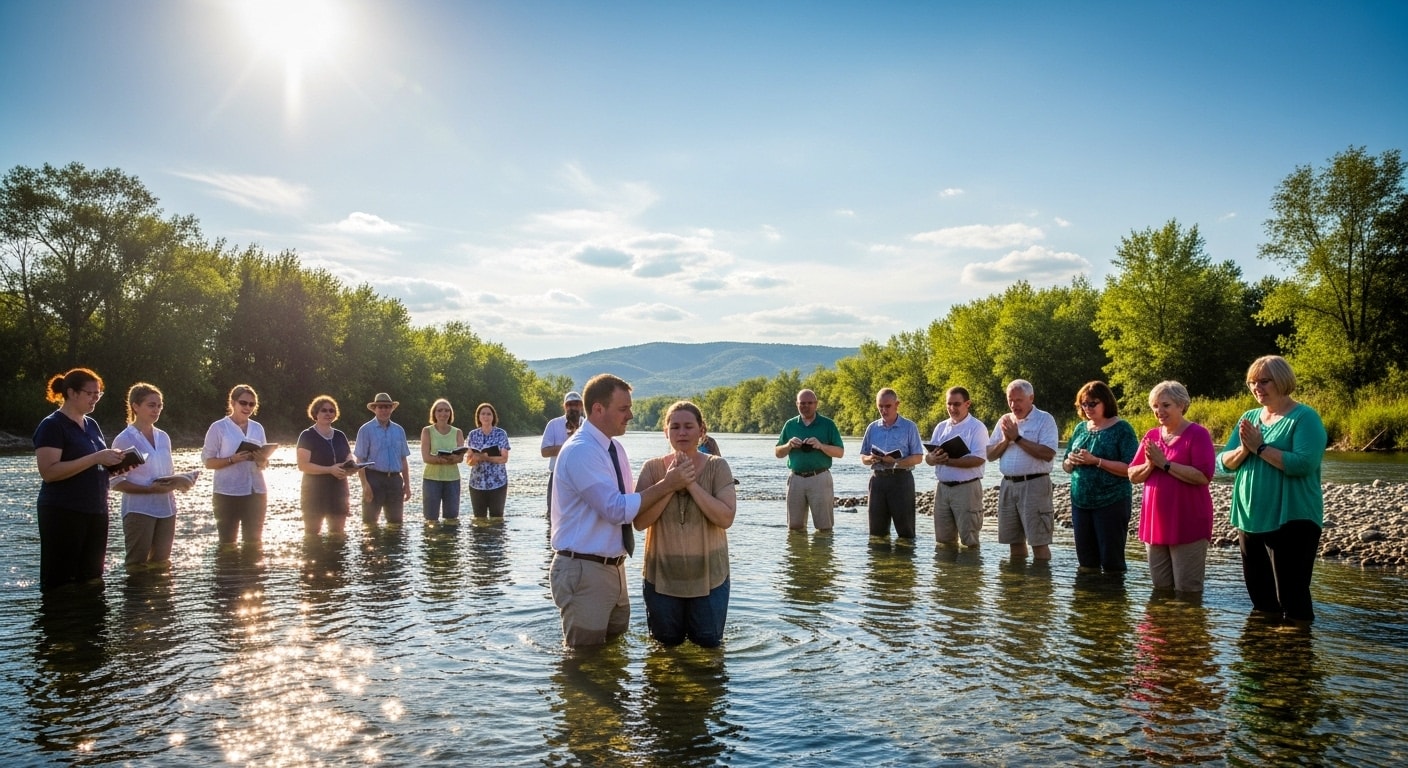
Christian water baptism is so common that many people don't consider that other types exist, leading to the perception that the word "baptism" always means water. This common misunderstanding can cause confusion when studying the Bible, as the term "baptism" ($\beta\alpha\pi\tau i \zeta \omega$ - baptizō) does not always refer to a water ceremony. Its core meaning is to immerse, submerge, or completely overwhelm—a concept the Scriptures apply to various experiences. The plurality is even mentioned in Hebrews 6:2 as "the doctrine of baptisms." Below is a comprehensive list of these ten baptisms as found in the King James Version (KJV) to help clarify their different meanings.
1. John's Baptism
A preparatory water immersion administered by John the Baptist. It was a public declaration of repentance from sin and anticipation of the Messiah's arrival. It was a transitional baptism, preceding the establishment of the New Covenant.
References: Matt. 3:6, 11; Mark 1:4-5; Luke 3:3; Acts 1:22; Acts 19:3-4
2. The Baptism of Jesus
Although administered by John, Jesus's own baptism was unique. It was not for repentance of sin (as He was sinless), but to "fulfil all righteousness" to identify with sinful humanity, to be anointed by the Spirit for His public ministry, and to be affirmed by the Father.
References: Matt. 3:13-17; Mark 1:9-11; Luke 3:21-22
3. The Disciples' Baptism
A transitional water baptism performed by Jesus's disciples during His earthly ministry. This baptism was functionally similar to John's, acting as an expression of faith in Jesus as the Messiah, but it predated the Great Commission and the coming of the Holy Spirit at Pentecost.
References: John 3:22; John 4:1-2
4. Christian Water Baptism
The ordinance commanded by Jesus after His resurrection. This water baptism is for believers, performed in the name of the Father, Son, and Holy Ghost. It is an outward symbol of an inward reality: the believer's union with Christ in His death, burial, and resurrection.
References: Matt. 28:19; Acts 2:38, 41; Acts 8:36-38; Rom. 6:3-4
5. Baptism with the Holy Spirit
The spiritual act, performed by Jesus Christ, whereby a believer is immersed into the "Body of Christ" at the moment of salvation. This is a non-experiential, universal reality for every Christian that unites them with Christ and all other believers.
References: Matt. 3:11; Acts 1:5; 1 Cor. 12:13; Gal. 3:27
6. Baptism with Fire
A baptism of judgment. Mentioned by John the Baptist, this refers to the future, overwhelming judgment and wrath of God that will be poured out upon the unrepentant. The "fire" is one of purification for the world but destruction for the wicked.
References: Matt. 3:11-12; Luke 3:16-17
7. Baptism of Suffering
A metaphor used by Jesus to describe His coming death on the cross. To be "baptized" in this sense meant to be completely overwhelmed and submerged by the agony and suffering of the atonement.
References: Mark 10:38-39; Luke 12:50
8. Baptism into Moses
A figurative or typological baptism used by the Apostle Paul. He describes the Israelites' passage through the Red Sea as being "baptized unto Moses in the cloud and in the sea," signifying their identification with Moses as their God-appointed leader and deliverer.
References: 1 Cor. 10:1-2
9. Baptism for the Dead
A practice mentioned only once by Paul in the context of arguing for the reality of the resurrection. The exact nature and meaning of this practice are heavily debated among theologians, and it is not commanded or explained anywhere else in Scripture. Paul mentions it as something "they" do, without endorsing or condemning it.
References: 1 Cor. 15:29
10. The One Baptism
After listing these many "baptisms," how do we understand Paul's statement that there is "one baptism"? Most theologians believe this refers to the singular, essential, and unifying Baptism with the Holy Spirit, which is the spiritual reality for every believer. This one spiritual baptism places us into the one Body of Christ, and it is this reality that Christian water baptism publicly illustrates in most of churchianity.
References: Ephesians 4:5
Join The Discussion
Disqus Comments Plugin will load here.