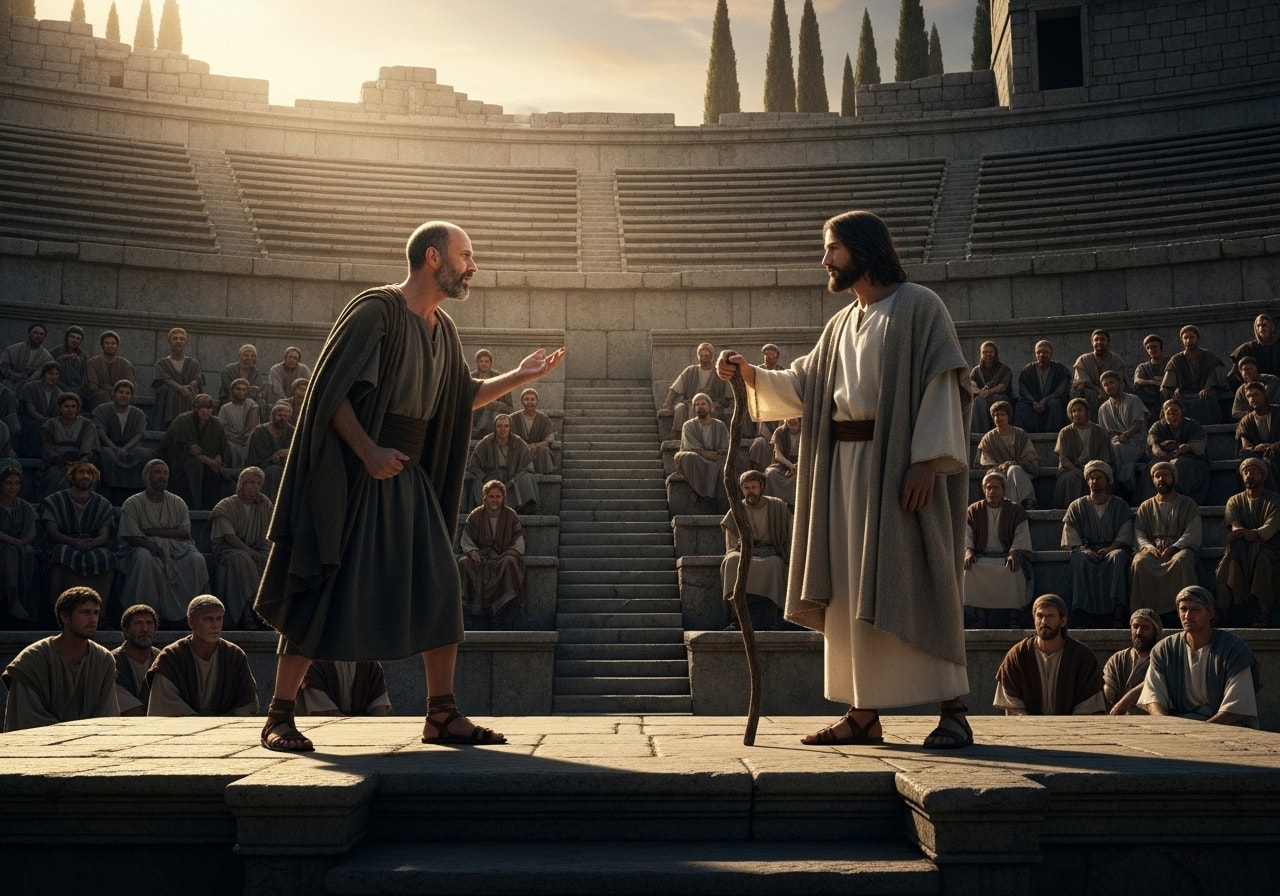
It’s a common and well-intentioned phrase among Christians: "I just follow Jesus." On the surface, this sounds like the purest form of devotion. But what does it mean to follow Jesus in our modern era, nearly 2,000 years after His earthly ministry? The Gospels provide a powerful record of His life, teachings, and sacrifice. They record His mission to a specific people, the nation of Israel, at a specific time under the Law (Matthew 15:24).
The key to understanding and obeying Christ's will for us today lies in recognizing the unique, divinely-appointed role of the Apostle Paul. Following Paul is not a choice of him over Christ. Instead, it is the God-ordained method for following the risen and glorified Christ in the current age.
One or Two Gospels?
To resolve apparent contradictions in the New Testament, one must first understand a critical distinction. The Bible describes two gospels for two different programs of God.
First was the gospel of the kingdom, preached by Jesus and the Twelve apostles. This gospel focused on the identity of Christ, that He was the Messiah, the Son of God. Critically, when Peter and the apostles preached the Lord’s death, they did not present it as good news for salvation but as a Jewish crime that required national repentance (Acts 2:22-24, 3:13-15). He demanded the nation repent of this act to be forgiven (Acts 2:36-38). To be saved under this message required faith in who Jesus was, but it also required works, including keeping the Mosaic Law and water baptism.
Second is Paul’s gospel of the grace of God. In dramatic contrast, this gospel focuses on the work of Christ, that He died for our sins, was buried, and rose from the dead (1 Corinthians 15:1-4). The cross is not a crime to be repented of, but the very message of salvation itself. Paul’s gospel requires only one thing for salvation: faith alone in that finished work, wholly apart from any works of our own (Ephesians 2:8-9). This is the gospel for the Church today. Understanding this fundamental difference is the necessary first step to reading the New Testament with clarity and without confusion.
A New Revelation from a Risen Christ
The doctrines Paul taught were not a continuation of what Jesus taught on earth. They were a "secret" that God had kept hidden throughout history until He revealed it directly to Paul. These new revelations initiated an entirely new program from God (Ephesians 3:3-9; Romans 16:25). This included the gospel of the grace of God, the nature of the Church as the body of Christ, and the full equality of Jew and Gentile in that body.
Crucially, Paul did not learn these truths from the other apostles or by studying Jesus' earthly ministry. He received them by direct revelation from the risen, glorified Lord Jesus Christ in His heavenly ministry. He declared his message was not from any human source but came "through a revelation of Jesus Christ" (Galatians 1:11-12). This direct commission marks the beginning of the Church, the body of Christ, which is a new creation distinct from God's program with the nation of Israel.
The Divine Pattern for the Church Age
The resurrected Lord Jesus Christ did not choose Peter or John to be the pattern for His new work of grace. He chose Saul of Tarsus, the "chief of sinners." (1 Timothy 1:15) God’s purpose in saving His fiercest enemy was profoundly strategic. He established Paul as a specific "pattern" for all who would believe during this current age of grace.
"However, for this reason I obtained mercy, that in me first Jesus Christ might show all longsuffering, as a pattern to those who are going to believe on Him for everlasting life."
1 Timothy 1:16
God's plan for saving Paul was profoundly strategic. Once a fierce persecutor of believers, Paul later explained this divine purpose himself. He declared that Christ came to save sinners, and that he was the "first" among them.
By saving the "worst of us first" (1 Timothy 1:15) God established Paul as a pattern. This pattern proves that His grace is sufficient for anyone.
Paul’s life became a living demonstration of grace. He rejected self-reliance. Instead, he gloried in his weaknesses so that Christ's power could be perfectly displayed in him. This is the model for a life crucified with Christ—a life where self is set aside so that Christ can live through the believer.
Because he embodied this, Paul could confidently command others to follow his example. He wrote, "Be ye followers of me, even as I also am of Christ" (1 Corinthians 11:1). He urged the Philippian church to do the same: "Brethren, be followers together of me, and mark them which walk so as ye have us for an ensample" (Philippians 3:17). To his ministry partner Timothy, he detailed exactly what this pattern entailed, reminding him, "But thou hast fully known my doctrine, manner of life, purpose, faith, longsuffering, charity, patience" (2 Timothy 3:10). In doing so, he was inviting them to follow the same pattern of grace that Christ had revealed through his life.
As the prime example of the boundless grace he preached, Paul was the first to be saved under this new program. This makes him the perfect template for every believer who would follow. It is for this reason that Paul, as our pattern, could confidently command believers to imitate him and the doctrine he received (1 Corinthians 11:1, 1 Thessalonians 1:6). This gives believers today tremendous clarity, knowing that God has provided a specific model to follow for faith and life in the Church.
So, Do We Ignore What Jesus Said?
This crucial distinction naturally raises a vital question. Does following Paul mean we set aside the words of Jesus in the Gospels? The answer is not a rejection, but a right-division. We must distinguish between Christ’s earthly ministry to Israel under the Law (Romans 15:8) and His current heavenly ministry through the Apostle Paul to the Church (Philippians 3:20; Ephesians 2:6; Ephesians 1:3; Colossians 3:1–2).
Most churches don't preach on this verse, but this is why Paul could write, "Wherefore henceforth know we no man after the flesh: yea, though we have known Christ after the flesh, yet now henceforth know we him no more." (2 Corinthians 5:16). In this context, "the flesh" refers to the earthly system of human life, particularly life lived under the Mosaic Law. Jesus Himself was "born of a woman, born under the law" (Galatians 4:4). His entire earthly ministry operated within that legal framework. Therefore, we do not follow His earthly ministry in the same way His disciples did. For example, believers today are not commanded to sell all their possessions. That was a specific instruction Jesus gave to a man living under the Law (Luke 18:22). Paul's point is clear. The way people knew and related to Christ during His time on earth is now in the past. Today, we know the risen, glorified Christ through the Spirit and the new revelation given to our apostle, Paul. This new perspective is essential for understanding our relationship with Him now.
The instructions Paul wrote in his epistles are the direct commandments of the risen Lord Jesus Christ for us today (1 Corinthians 14:37). To obey Paul’s doctrine is to obey the ascended Christ. The teachings in the Gospels were for Israel, leading up to the offer of their kingdom. The teachings in Paul’s letters are for the Church, His body in this present age.
Everything Paul received, he received from the risen Christ. Refusal to follow Paul means refusal to follow Christ. The Church is not Israel. Through Paul, Christ founded the Church and gave him all the doctrines concerning the Church. Unless one understands this, one cannot follow Christ today.
How Other Views Miss the Mark
Understanding the Pauline distinction becomes clearer when contrasted with other major theological systems. Both Covenant Theology and traditional Dispensationalism handle the relationship between Jesus and Paul differently, which leads to significant doctrinal problems.
Covenant Theology (e.g., Presbyterian)
Covenant Theology views God's plan as a single, unfolding "Covenant of Grace" for a single people of God. In this system, the Church is the "New Israel," inheriting the promises and identity of Old Testament Israel.
Jesus vs. Paul: Jesus and Paul are on a direct continuum. The Sermon on the Mount is seen as the ethical foundation for the Church, and Paul’s letters are read as expansions of Jesus’ earthly teachings. There is no sharp break or new program.
The Problem: This view creates significant doctrinal confusion by failing to distinguish between God's program for Israel and His "mystery" program for the Church. This leads to several major issues:
- It Mixes Law and Grace: By treating the Church as "New Israel," it incorrectly burdens believers with commands and principles from the Mosaic Law, such as Sabbath-keeping or tithing, creating confusion about how to live a life of grace. Ordinances like water baptism and communion (juice and bread) are ways to receive grace by doing ceremonial rituals actions (law based works). It adds further confusion of grace vs law and our position in Christ.
- It Requires Non-Literal Interpretation: To make specific, earthly promises given to national Israel fit the Church, this system must "spiritualize" or allegorize large portions of Scripture, rather than taking them at their plain, literal meaning. To make scripture for Israel fit the Church, covenant theologians must reinterpret verses about Israel's conditional, Law-based relationship with God. In doing so, they obscure the fundamental difference between the law program and the unconditional grace offered to the Church today.
- It Undermines Paul: It fails to recognize Paul’s doctrines about the Body of Christ as a truly new "mystery" that was hidden in ages past. Instead, it blends these truths into Old Testament prophecy, obscuring the uniqueness of the current age and the specific authority of Paul as our apostle.
Dispensationalism
Dispensationalism correctly distinguishes between Israel and the Church as two distinct peoples of God with different destinies. This is a closer step in the right direction, but they still have many confusing doctrines. For instance, Baptists still based their doctrines on John the Baptist, a completely different program from our current time.
Jesus vs. Paul: This view sees a transition from Jesus' kingdom message to Paul's grace message. However, it marks the beginning of the Church at the Day of Pentecost in Acts 2.
The Problem: Pinpointing the Church’s origin in Acts 2 creates confusion. The ministry in early Acts, led by Peter, is still Israel. The apostles continue temple worship, practice Jewish customs, and preach a message of national repentance to Israel (Acts 2:38, 3:19). Is pentecostalism with tongue speaking, prophecy, healings, and casting out demons valid signs of today? If we follow an Acts 2 pattern, miraculous tongue speaking certainly makes sense. However, Baptists would reject these as modern signs. Confused? This Acts 2 message, which includes water baptism for the remission of sins, looks very different from the gospel of pure grace Paul later preached. If the Church began in Acts 2, then Peter, not Paul, should be the primary pattern. This "transitional" period mixes elements of Israel's program with the Church's program, obscuring the radical newness of the revelation given to Paul.
Rightly Dividing Key Doctrines
A comparison of how major theological systems interpret core beliefs.
| Aspect | Presbyterian (Covenant) View | Baptist Dispensational View | Pentecostal Charismatic View | Mid-Acts View |
|---|---|---|---|---|
| Acts 2 | The historical inauguration of the New Covenant Church. | A unique historical event to launch the Church as a distinct entity. | A pattern to be replicated by the Church today. | Part of the continuation of the kingdom program to Israel, before the Body of Christ began. |
| Sign Gifts | Historically Cessationist. Gifts authenticated the apostles and are no longer operative. | Had a foundational purpose and ceased with the apostles. (Cessationism) | Normative for all believers in all ages. (Continuationism) | Signs for Israel's prophetic program. Not part of the "mystery" program for the Body of Christ. |
| Great Commission | Emphasizes the Matthew 28 version as the direct command to the church. | Emphasizes the Matthew 28 version, distinct from Israel's program. | Emphasizes the Mark 16 version with its promise of signs. | Belongs to Israel and the kingdom program. The Church's commission is the Ministry of Reconciliation (2 Corinthians 5:18-20). |
| Water Baptism | A sacrament and sign of the New Covenant that replaces circumcision; administered to believers and their infants. | An ordinance for believers only, symbolizing identification with Christ. | An ordinance and an act of obedience for believers, following the Acts 2:38 model. | Part of Israel's kingdom program; not for today. The "one baptism" for the Church is spiritual (Eph. 4:5; 1 Cor. 12:13). |
| Leader/Example to Follow | Jesus' earthly teachings (e.g., Sermon on the Mount) are the direct ethical commands for the Church. | Jesus is the ultimate head; Paul's epistles are the primary source for church doctrine and practice. | Jesus' earthly ministry and the apostles in Acts are the primary pattern for a spirit-filled life. | The Apostle Paul is the exclusive pattern for the believer in the Body of Christ (1 Tim. 1:16; 1 Cor. 11:1). We follow the risen Christ through Paul. |
The Mid-Acts Pauline Resolution
Mid-Acts Dispensationalism resolves these issues by recognizing that the Church, the Body of Christ, began not at Pentecost but with the new revelations given to the Apostle Paul. This provides a clean break. Paul is the true and exclusive apostle and pattern for the Church today (1 Timothy 1:16). It allows us to rightly divide the Word, applying Israel's program to Israel and the Church's "mystery" program to the Church. We can eliminate contradictions and provide doctrinal clarity.
A New Lens for Reading Scripture
Understanding Paul’s unique role is not about choosing him over Jesus. It is an act of obedience to the specific instructions the risen Christ revealed through Paul for His body, the Church. This framework distinguishes God's prophetic program for Israel from the hidden mystery of the Church (Colossians 1:26-27). This approach allows us to see the Bible not as a collection of conflicting commands, but as the progressive, revelation of God. It is how we faithfully follow Christ today.
Now that you see Paul as the Christ centered pattern for the Church, how does it change the way you read your Bible?
Join The Discussion
Disqus Comments Plugin will load here.