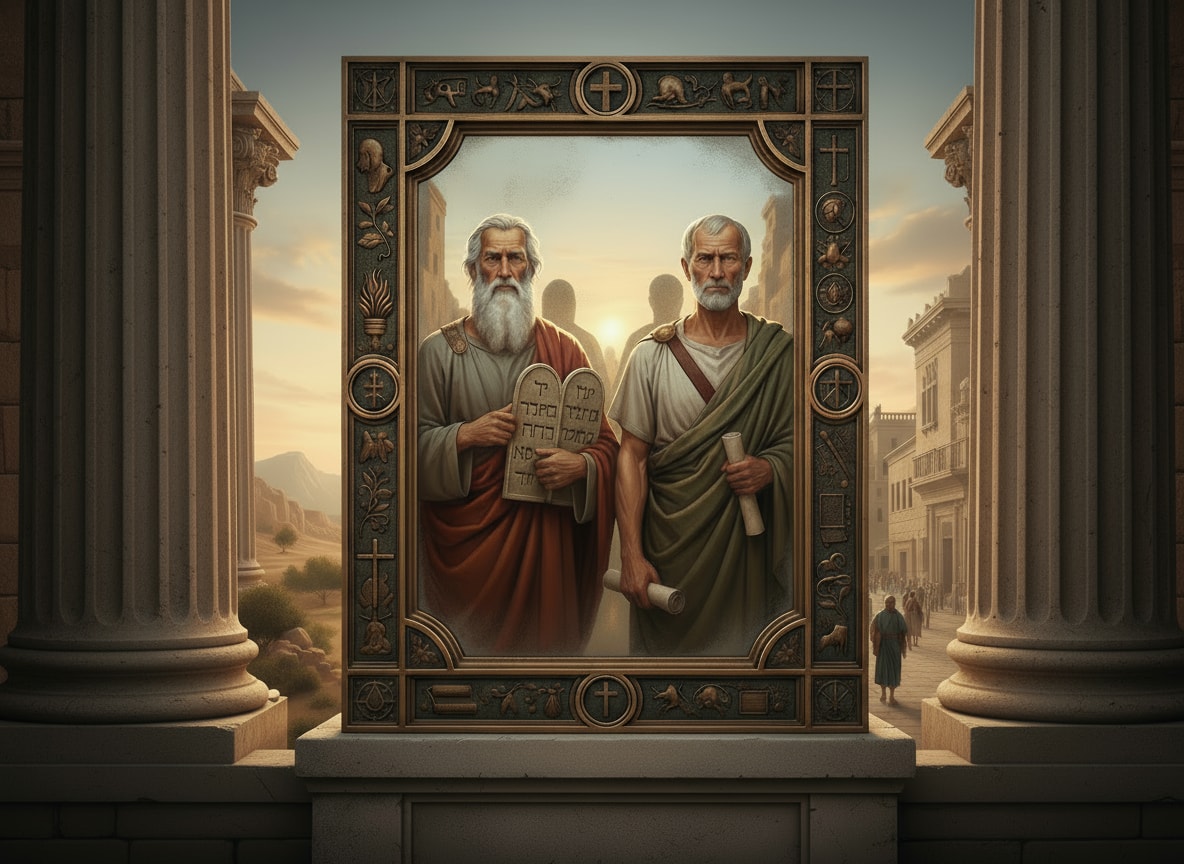
Have you ever felt confused while reading the Bible? One passage seems to say one thing, while another says something completely different. This isn't a mistake in Scripture. Often, the confusion comes from not understanding the two most important ministries in the Bible: the ministry of Moses and the ministry of the Apostle Paul.
Failing to see the clear line between the Law given through Moses and the Grace revealed through Paul is the main source of confusion that has troubled the Church for centuries. It causes the trumpet of the Gospel to give an "uncertain sound" (1 Corinthians 14:8).
In this article, we will explore these two God given ministries. While both were ordained by God, they had different purposes, different audiences, and different messages. Understanding their unique roles is the key to rightly dividing the word of truth and finding clarity in your faith.
Moses: God's Man for the Law and for Israel
To grasp the revolutionary message Paul brought, we first need to look back at Moses. God's entire relationship with the nation of Israel was built on the authority He gave to one man. Moses was the single channel through which God delivered the Law.
A Unique God Given Authority
Moses' authority wasn't his own. It came directly from God, setting him apart from everyone else. The Bible shows us just how special his commission was.
- God spoke to Moses "face to face, as a man speaketh unto his friend" (Exodus 33:11). This was a level of intimacy no other prophet experienced.
- Moses understood his specific role. He commanded Israel, "Ye shall not add unto the word WHICH I COMMAND YOU, neither shall ye diminish ought from it" (Deuteronomy 4:2). He used "I" not out of pride, but to emphasize that his words were God's commands for them.
- Even Jesus, during His earthly ministry, upheld this authority. He told the people, "The scribes and the Pharisees sit in Moses' seat: All therefore whatsoever they bid you observe, that observe and do" (Matthew 23:2-3).
The Danger of Challenging Moses
Because Moses was God's chosen man, challenging him was the same as rebelling against God. The consequences were severe.
- Miriam, his own sister, questioned if God only spoke through Moses. For this, she was struck with leprosy (Numbers 12:2, 9-10).
- Korah and his followers challenged Moses' leadership. As a result, the earth opened up and swallowed them (Numbers 16:31-32).
These events teach a vital lesson: God appoints specific people for specific programs, or dispensations. To rebel against His chosen messenger is to rebel against Him. This same model of unique, God-given authority helps us understand the special role of the Apostle Paul.
Paul: God's Man for Grace and the Church
Just as Moses was the dispenser of Law to Israel, the Apostle Paul was God's chosen dispenser of Grace to the world. Paul's ministry wasn't just the next step; it was a radical shift. He introduced a "mystery" program for the Body of Christ, something completely new and separate from the Law of Moses.
A New Message from the Glorified Christ
Like Moses, Paul didn't appoint himself. His authority came directly from the risen and glorified Lord Jesus Christ in heaven.
- A Direct Revelation. Paul made it clear his message wasn't second-hand. "For I neither received it of man, neither was I taught it, but by the revelation of Jesus Christ" (Galatians 1:12).
- The Apostle of the Gentiles. Paul had a specific audience. He declared, "I am the apostle of the Gentiles; I MAGNIFY MINE OFFICE" (Romans 11:13). This wasn't a title he chose, but a role given to him by God.
- A New Dispensation. Paul was given a program that had been hidden since the world began. He calls it "THE DISPENSATION OF THE GRACE OF GOD which is given me to you-ward" (Ephesians 3:2). This wasn't a sequel to the Law. It was a brand new operating system for believers.
- The Words of Christ. Paul's writings weren't just his opinions. They were the commands of Christ for us today. He challenged those who doubted him, "Since ye seek a proof of Christ speaking in me" (2 Corinthians 13:3). To ignore Paul is to ignore the Lord. To disobey Paul is to disobey the Lord.
You might notice Paul defends his apostleship many times in his letters. This wasn't about ego. He knew that the life changing message of Grace was tied directly to his unique, God given authority. He humbly called himself the "chief of sinners" (1 Timothy 1:15) and "less than the least of all saints" (Ephesians 3:8). His goal was always to magnify his office, not himself, for the sake of the Gospel.
Comparison of Law vs. Grace
When you place the teachings of Moses and Paul side by side, the differences become impossible to ignore. They represent two distinct programs from God. Trying to mix them is the root of so much theological confusion. Here is a simple breakdown.
| Topic | Moses (The Law for Israel) | Paul (Grace for the Church) |
|---|---|---|
| Core Principle | Law. Demanded strict obedience for blessing. The Law brought knowledge of sin (Romans 3:20), worked wrath (Romans 4:15), and was a "ministration of death" (2 Corinthians 3:7). | Grace. Salvation is a free gift, based entirely on Christ's finished work. Where sin abounded, "grace did much more abound" (Romans 5:20). We are "not under the law, but under grace" (Romans 6:14). |
| Our Inheritance | Earthly. Focused on Israel's physical inheritance of the land of Canaan. Moses spoke of "the land whither ye go to possess it" (Deuteronomy 4:1). | Heavenly. Our focus is on our spiritual position. God has "made us sit together in heavenly places in Christ Jesus" (Ephesians 2:6). Our hope is "laid up for you in heaven" (Colossians 1:5). |
| Relationship to God | Through Covenants. Israel's relationship with God was based on keeping covenants. Moses warned, "lest ye forget the covenant of the Lord your God" (Deuteronomy 4:23). | Through Christ. Gentiles were once "strangers from the covenants of promise" (Ephesians 2:12). Our blessing isn't based on a covenant, but on our position in Christ. |
| Access to God | Veiled. God's presence was real but separated by a thick veil in the temple. Only the High Priest could enter, and only once a year with blood (Hebrews 9:7). | Unveiled. The veil is torn! Every believer now has "boldness to enter into the holiest by the blood of Jesus" (Hebrews 10:19). We all have direct access to the Father (Ephesians 2:18). |
| Warfare | Physical. Israel was commanded to fight physical battles against enemies of "flesh and blood" to take their promised land (Deuteronomy 4:38). | Spiritual. Our battle is entirely different. We wrestle "not against flesh and blood, but against principalities, against powers... against spiritual wickedness in high places" (Ephesians 6:12). |
What Happens When We Mix Law and Grace? A Warning from Galatia
Following Paul's message of grace isn't an option. It's essential for spiritual health. The churches in Galatia provide a tragic example of what happens when believers mix the programs of Moses and Paul. Law and grace do not mix, otherwise it is not grace anymore! (Romans 11:6; Galatians 2:21)
The Galatians started well, receiving the pure "gospel of the grace of God" from Paul. But soon, false teachers convinced them to add rules from the Law of Moses to their faith. They thought they were being more obedient to God, but they were actually disobeying the specific truth God had revealed to them through Paul.
Paul rebuked them harshly, "O foolish Galatians, who hath bewitched you, that ye should not obey the truth?" (Galatians 3:1). This departure from grace had devastating results:
- They were "removed... unto another gospel" (Galatians 1:6).
- They lost the joy of their salvation. Paul asked, "Where is then the blessedness ye spake of?" (Galatians 4:15).
- They began fighting among themselves, "consumed one of another" (Galatians 5:15).
- Worst of all, by trying to be justified by the Law, Paul said, "Christ is become of no effect unto you... ye are fallen from grace" (Galatians 5:4).
The Galatian error is repeated everytime the Church mixes the Law of Moses with Paul's simple grace message. It replaces joy with division and creates an "uncertain sound" that confuses believers and the lost world.
Our Marching Orders: Stand Firm in Grace
The conclusion is simple but profound. Moses was God's man for the Law, given to the nation of Israel. Paul was God's man for grace, given to the Church, the Body of Christ.
Recognizing the unique authority of the Apostle Paul isn't about worshipping a man. It is about obeying the glorified Lord Jesus Christ and His revealed plan for us today. Paul's letters are not just part of the New Testament. They are the specific instructions—our "private mail"—for the Body of Christ. They contain our doctrine, our position, and our mission.
The key to ending theological confusion and restoring spiritual joy is to rightly divide the Word of Truth. Our mission today is not found in the legal demands of Moses, but in the glorious "gospel of the grace of God" that was revealed to and through Paul, the apostle of the Gentiles.
Join The Discussion
Disqus Comments Plugin will load here.