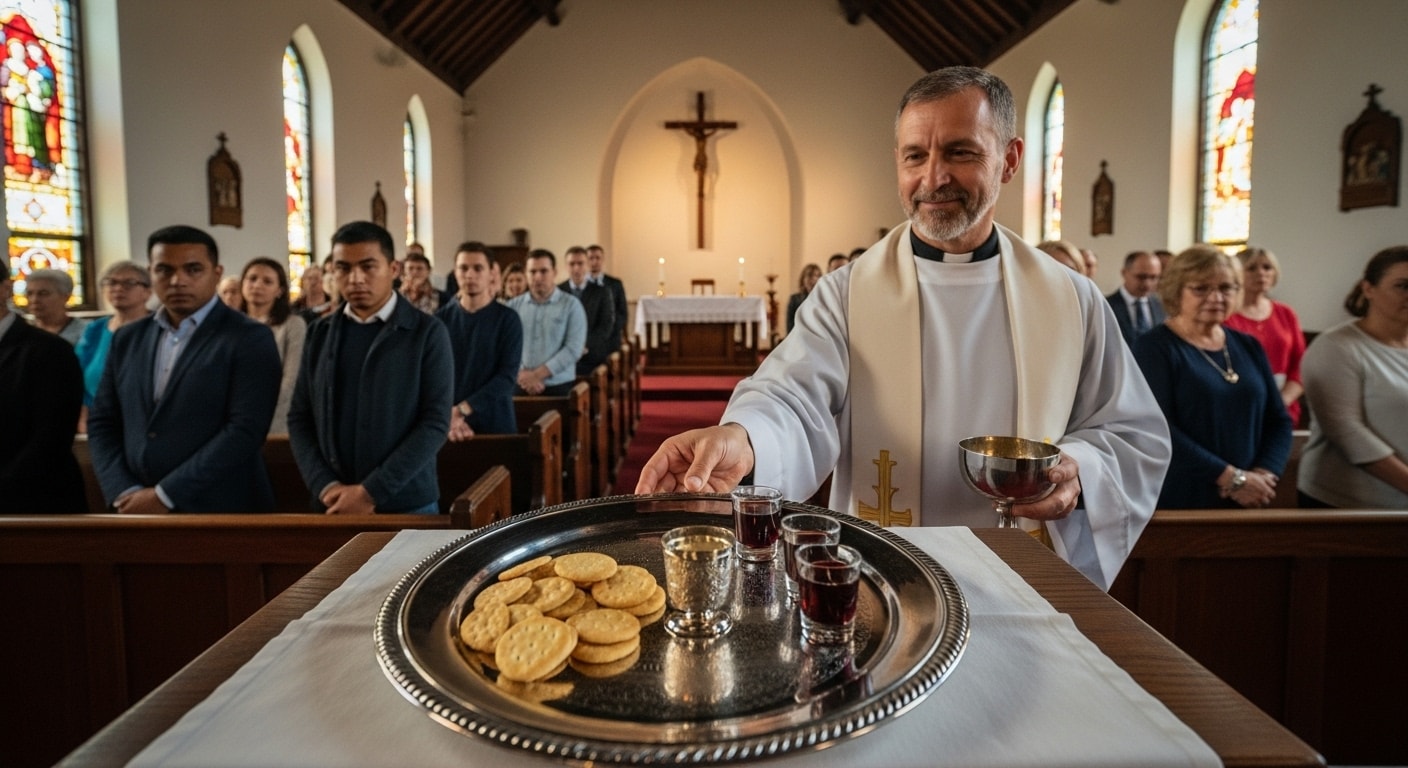
In churches across the globe, a familiar ceremony takes place. A tiny wafer and a thimble of juice are passed down the pews in a moment of quiet reflection. This solemn tradition is revered, but it is a tradition that has drifted far from the biblical reality. When the Bible is rightly divided, it reveals that the church’s communion is not a somber ritual of sacramental snacks, but a joyful celebration of a profound, living truth. It is time to challenge our assumptions and rediscover the doctrine as it was revealed for the church today.
The Last Supper Wasn't for the Church
Most Christians incorrectly trace their communion practice to Jesus' last Passover meal with His disciples (Matthew 26:26, Luke 22:14-20). A careful study of the context, however, shows this event was exclusively for Israel under the Old Covenant. The cup represented the blood of the New Testament for Israel, not a universal church ordinance.
From a mid-Acts dispensational standpoint, the church, the Body of Christ, had not yet been revealed. Everyone at that table was a Jew. Furthermore, the atmosphere was not one of celebration but of profound sorrow. It was during this meal that Jesus identified His betrayer, prompting distress, not joy, among the disciples.
"But, behold, the hand of him that betrayeth me is with me on the table."
Luke 22:21
"And they were exceeding sorrowful…"
Mat 26:22
This sorrowful Passover, freighted with the weight of betrayal and a necessary sacrifice for the nation of Israel, is doctrinally distinct from the joyous communion of the Body of Christ.
Church Communion is a Pauline Revelation
The doctrine of communion for the church in this dispensation is found exclusively in the epistles of the Apostle Paul. The very terms "Lord's supper" and "communion" appear only in his letter to the Corinthians. This teaching is directly associated with the revelation of the "mystery of Christ" (Ephesians 3:9), that is, the formation of the church, the Body of Christ, a truth kept secret during Jesus's earthly ministry.
Because this is a new revelation, we are not to pattern our practice on Christ’s earthly ministry to Israel. Paul makes this clear, stating:
"Wherefore henceforth know we no man after the flesh: yea, though we have known Christ after the flesh, yet now henceforth know we him no more."
2 Corinthians 5:16
Paul’s doctrine repurposes the elements to teach a different truth. In Luke, the bread and cup signified a necessary sacrifice for Israel's new testament. For the church, Paul reveals they teach the common free gift of salvation we share in Christ.
The "One Bread" is the Church
For the Body of Christ, Paul authoritatively redefines the symbolism of the elements. He explains that the bread is not a representation of Jesus' physical flesh, but rather a powerful symbol of the church itself, the unified Body of believers.
"The cup of blessing which we bless, is it not the communion of the blood of Christ? The bread which we break, is it not the communion of the body of Christ? For we being many are one bread, and one body: for we are all partakers of that one bread."
1 Cor 10:16-17
This Pauline doctrine shifts the focus from a mystical sacrament to a practical reality. The following table contrasts the traditional view drawn from Israel's gospels with the doctrine revealed to Paul for the church.
| Traditional View (from Israel's Gospels) | Pauline Doctrine (from Paul's Epistles) |
|---|---|
| The bread represents Jesus' physical body. | The "one bread" represents the church, the unified Body of Christ. |
| The cup represents the blood of Jesus shed in shame for Israel. | The cup represents the communion of the blood that bought salvation and forgiveness for all men, not under any covenants. |
| A solemn memorial of a necessary sacrifice. | A joyous celebration of our common salvation and position in Christ. |
The "Lord's Supper" in Corinth Was a Real Meal
The only mention of the "Lord's supper" in Scripture is found in Paul’s sharp rebuke to the Corinthian church (1 Corinthians 11:20-21). The problems he confronts prove they were not performing a quiet ritual. Paul notes that some were going hungry while others were getting drunk. This could only happen during a full meal, not a ceremony with a cracker and a sip of juice.
The core issue was not improper ceremony, but carnal, selfish, and divisive behavior. They were eating their "own supper" separately instead of the "Lord's supper" together. The theological weight of Paul's rebuke lies in the powerful contrast he draws. He reminds them of the Last Supper not as a pattern to be ritually imitated, but as an example of Christ's charity to be functionally emulated.
The night He was betrayed, surrounded by those who would abandon and deny Him, Jesus said, "Take, eat." He did not gorge Himself or keep it all to Himself. He showed ultimate charity. The Corinthians, in stark contrast, were disrespecting their own brothers and sisters in Christ, demonstrating profound selfishness. The solution was not a more reverent ritual, but genuine love and unity.
"…when ye come together to eat, tarry one for another."
1 Cor 11:33
True Communion is a Practice, Not a Ritual
Biblical communion is our "common union"—with Christ and with each other. It is not a sacrament to be performed, but a reality to be practiced.
This practice is manifest when believers come together to eat, celebrate, and rejoice in the finished work of Christ. It is about fellowship and walking in service to one another with the same mind and the same love (Philippians 2:1-4). This is how we truly remember the Lord's death, His resurrection, and our shared life in Him. Every shared meal is an opportunity to express the profound unity we have as members of His Body.
"Whether therefore ye eat, or drink, or whatsoever ye do, do all to the glory of God.”
1 Cor 10:31
Conclusion
Scripture is clear: biblical communion is not about a sacramental wafer, but about the joyful, shared life believers possess in the Body of Christ. It is a living expression of our unity, purchased by His blood and celebrated in fellowship with one another. To reduce this vibrant reality to a quarterly ritual is to miss the point entirely. Understanding this truth should transform our perspective and our practice. The question, then, is not merely academic: How might our church gatherings change if we saw every shared meal as an opportunity to practice true communion?
Join The Discussion
Disqus Comments Plugin will load here.