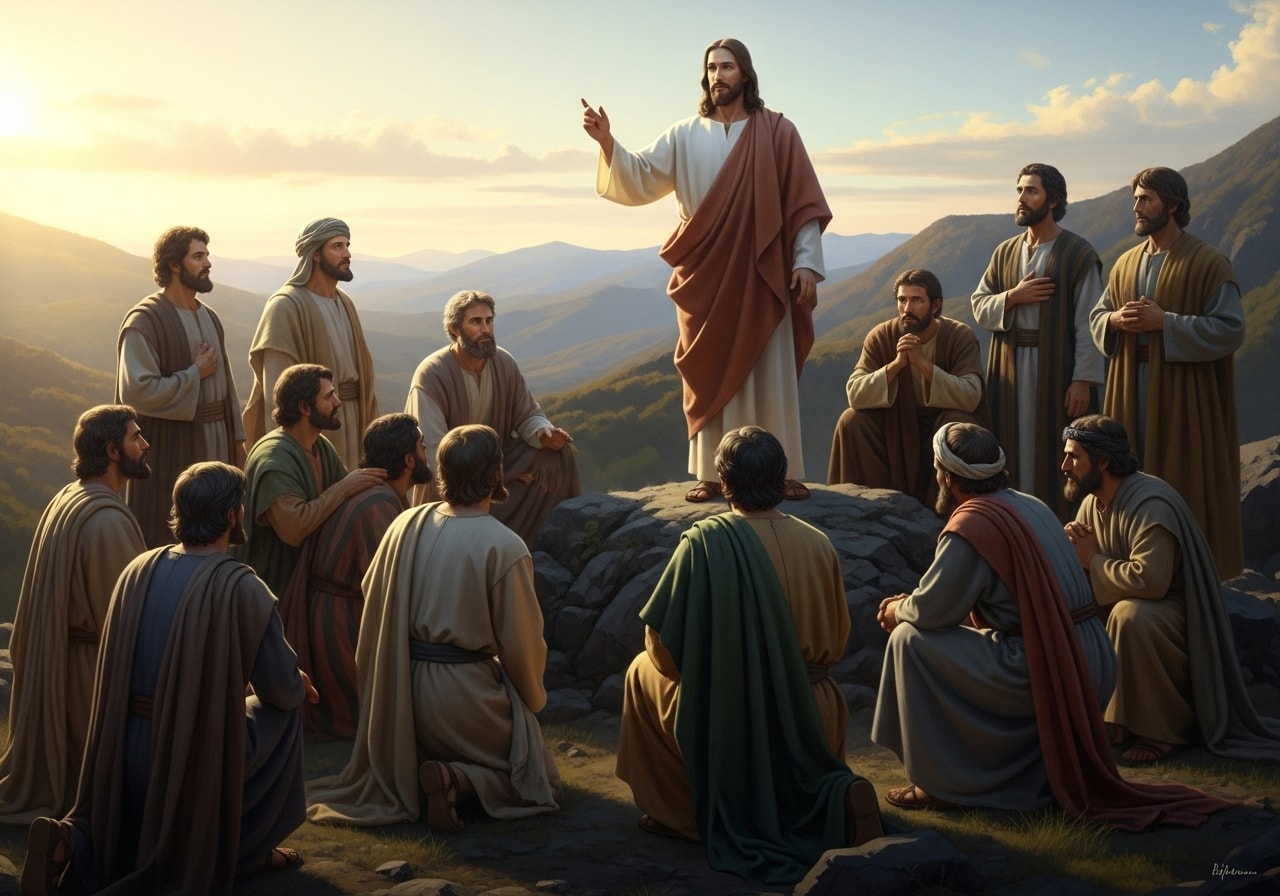
Reviewing Our Marching Orders
For centuries, Christians have universally recognized the commands in Matthew 28:18-20 and Mark 16:15 as their definitive "marching orders." This "Great Commission," as it has come to be known, is the foundation upon which global missions have been built and the primary directive for evangelism. We embrace the call to "go into all the world," and we teach and baptize in obedience to what we believe is Christ's final, binding command to His Church. Many churches use Matthew 28 as their mission statement. What if they are wrong? What if their entire mission statement is missing the mark?
The Great Commission is considered another sacred cow of churchianity, and to critically examine and question this doctrine is equivalent to heresy for many. Who could deny that sharing the gospel with others is a bad thing? How could someone disagree with sharing the gospel with the world and the lost? But this brings more issues into view, as the great commission and the gospel we know today (1 Corinthians 15:1-4) is not what any of the verses in Matthew, Mark, Luke, or John talk about. It is a good thing to have a biblical ministry and commit to seeing others saved.
A closer look at the text reveals some profound inconsistencies in how we apply these commands today. Why do we eagerly accept the command to "go," (Mark 16:15) but conveniently ignore the verses immediately following that promise believers they will handle snakes, drink deadly poison without harm, and cast out devils? (Mark 16:17-18) We champion the call to "teach all nations," but what exactly did Christ command the apostles to teach? If we are honest, a disconnect exists between the commission as written and the commission as practiced.
This article will explore surprising and counter-intuitive takeaways from a deep dive into the scriptural accounts of the so-called "great commission." A title, it should be noted, that the Bible itself never even uses. It's a completely man-made name. Our purpose is not to diminish the call to share our faith, but to dispel the crippling confusion that has divided the Church for centuries by re-examining what Christ's commission truly entails and to whom it was specifically given.
Our purpose is not to diminish the call to share our faith, but to dispel the crippling confusion that has divided the Church for centuries by re-examining what Christ's commission truly entails and to whom it was specifically given.
There Isn't One 'Great Commission.' There Are Five. They Don't All Say the Same Thing.
A surprising truth is that the instructions Jesus gave to the apostles between His resurrection and ascension are not recorded in one neat package. They are spread across five different accounts in Matthew, Mark, Luke, John, and Acts. When examined together, their unique points of emphasis reveal a more complex picture than is often presented.
- Matthew 28:18-20: The primary emphasis here is on teaching new disciples to observe "all things whatsoever I have commanded you," a command that stands in direct opposition to the believer's freedom in grace. More on this below.
- Mark 16:15-18: This account uniquely and directly links belief and baptism to salvation ("He that believeth and is baptized shall be saved"). It is also the only version that lists specific, miraculous signs that "shall follow them that believe," including casting out devils, speaking in new tongues, and handling serpents.
- Luke 24:45-48 & Acts 1:8: These parallel accounts stress a specific geographic sequence for the apostles' ministry. Their work was to have a clear starting point and progression: "beginning at Jerusalem," then moving outward to all Judaea, Samaria, and finally to the uttermost parts of the earth.
- John 20:21-23: John's account includes a unique and often overlooked element: the authority given to the apostles to remit or retain sins ("Whose soever sins ye remit, they are remitted unto them"), a level of apostolic authority that Protestant churches today almost universally reject for themselves.
This diversity has caused significant confusion throughout Church history, with even great Bible teachers disagreeing on which version constitutes the "true" commission for today. This fundamental disagreement among giants of the faith is the first clue that perhaps the Church has been trying to follow the wrong set of orders all along.
A Literal Reading Would Require Obeying the Law of Moses and Selling Everything You Own.
The account in Matthew contains a command that, if applied literally today, would fundamentally alter modern Christian practice. In Matthew 28:20, Jesus instructs the apostles to be "Teaching them to observe all things whatsoever I have commanded you."
What did Jesus command His disciples during His earthly ministry? First, since Jesus was "made under the law" (Galatians 4:4) and taught his disciples to obey the scribes and Pharisees who sat in "Moses' seat" (Matthew 23:1-3), this command to observe "all things" would necessarily bind believers to the Law of Moses. This stands in stark contrast to the Apostle Paul's clear teaching that believers in this age are "not under the law, but under grace" (Romans 6:14).
Furthermore, the phrase "all things whatsoever I have commanded you" would include other radical directives. Consider His commands in the Sermon on the Mount to "Take no thought for your life, what ye shall eat..." (Matt. 6:25-26) or in Luke 12:33: "sell that ye have, and give alms." This is not a theoretical problem. It is a direct historical proof that the apostles were operating under this specific, now-impossible command. In Acts, we see them taking this literally: believers "sold their possessions and goods, and parted them to all men, as every man had need" (Acts 2:44-45) and "had all things common" (Acts 4:32-35). Yet this directly contradicts Paul's later instruction in 1 Timothy 5:8, which states that anyone who fails to provide for his own household "hath denied the faith, and is worse than an infidel."
We cannot simultaneously obey both commands. This powerful inconsistency serves as a concrete historical marker of a superseded program.
The 'Miraculous Signs' Clause Creates an Uncomfortable Inconsistency.
Mark's account of the commission presents a significant challenge for most churches that claim it as their own. Mark 16:17-18 is explicit: "And these signs shall follow them that believe; In my name shall they cast out devils; they shall speak with new tongues; They shall take up serpents; and if they drink any deadly thing, it shall not hurt them; they shall lay hands on the sick, and they shall recover.”
The text does not say these signs would follow a select few apostles or only those with special gifts. It says these signs "shall follow them that believe", believers in general, as the evidence of salvation under that program. This creates a glaring inconsistency in modern application. Many churches and leaders who claim to follow the "Great Commission" from Mark will preach passionately about the necessity of baptism from verse 16 but will completely ignore, or even forbid, the list of signs in Mark 16:17-18.
Dr. I. M. Haldeman, a famous pastor, provides a stark example. He required water baptism for church membership but would excommunicate any member who practiced speaking in tongues. This picking-and-choosing demonstrates the folly of trying to selectively apply a commission that was meant to be taken as a whole. This wasn't a pick-and-choose affair for the apostles. Peter's sermon on the day of Pentecost was a direct, holistic application of Mark's commission, seamlessly uniting repentance, baptism for remission of sins, and the promise of a supernatural gift:
"Then Peter said unto them, Repent, and be baptized every one of you in the name of Jesus Christ for the remission of sins, and ye shall receive the gift of the Holy Ghost." (Acts 2:38).
The Original Apostles Agreed Their Commission Was Superseded.
Perhaps the most compelling evidence that the commission in the Gospels was not the Church's final orders comes from the apostles themselves. Years after Christ's ascension, a pivotal meeting took place in Jerusalem, described in Galatians 2:7-9.
At this council, the leaders of the Jerusalem church: James, Peter (Cephas), and John met with the Apostle Paul. The scripture says they "perceived the grace" that was given to Paul, recognizing that his ministry and message were distinct from their own. The outcome of this meeting was a formal, Spirit-led agreement to divide their ministries. Paul states the conclusion directly: they gave him the right hand of fellowship, agreeing "that we should go unto the heathen, and they unto the circumcision." (Galatians 2:9).
This was not a casual suggestion. It was a formal, Spirit-led redrawing of ministerial boundaries. The very men tasked with going to "all nations" formally acknowledged that their commission, tied to the gospel of the kingdom for Israel, had been superseded. They handed the primary responsibility for the Gentile world to Paul, recognizing him as God's chosen apostle for a new program.
The very men tasked with going to "all nations" formally acknowledged that their commission, tied to the gospel of the kingdom for Israel, had been superseded.
Our Commission Today Is Not Found in the Gospels, But in Paul's Epistles: The Ministry of Reconciliation.
If the commission to the eleven has been superseded, then what are our marching orders today? The scriptures reveal that a new commission was given to the Apostle Paul, specifically for the current "dispensation of the grace of God." This commission, the "gospel of the grace of God," is identified in 2 Corinthians 5:18-20 as "the ministry of reconciliation."
Paul explains that God "hath given to us the ministry of reconciliation," and its core message is a plea, not a command backed by signs or laws. It is a message of pure grace, centered on the finished work of Christ on the cross. The heart of this commission is found in Paul's appeal:
Now then we are ambassadors for Christ, as though God did beseech you by us, we pray you in Christ's stead be ye reconciled to God. For He hath made Him to be sin for us, [Him] who knew no sin; that we might be made the righteousness of God in Him.
This was not an evolution of the old commission, but the revelation of a completely new, previously hidden program from God. This glorious secret, "kept secret since the world began" (Rom. 16:25), is defined by what the "gospel of the kingdom" does not say. Paul's message is centered on previously hidden truths: the "preaching of the cross" as good news, salvation by grace through faith alone, redemption through Christ's shed blood, the formation of the Body of Christ where there is no Jew or Gentile, and our secure heavenly position in Christ. This is the glorious message entrusted to believers today.
This was not an evolution of the old commission, but the revelation of a completely new, previously hidden program from God.
A New Commission for a New Creation
A careful, objective look at Scripture reveals that the so-called Great Commission was a specific set of instructions for the eleven apostles, designed for a specific program, the gospel of the kingdom, directed at the nation of Israel. That program was interrupted by Israel's rejection of their Messiah, and God, in His infinite grace, ushered in a new dispensation and a new commission through the Apostle Paul.
Our commission today, our true marching orders, is not a blend of law, signs, and kingdom proclamation. It is the "ministry of reconciliation" (2 Corinthians 5:18-20). A message of pure grace that offers peace with God based entirely on the finished work of Jesus Christ. This understanding doesn't diminish our responsibility. It clarifies it, equipping us with the pure, powerful "gospel of the grace of God" for this age. If our primary mission is to "pray" others "in Christ's stead, be ye reconciled to God," how might that change the way we approach sharing our faith with the world?
Our commission today, our true marching orders, is not a blend of law, signs, and kingdom proclamation. It is the "ministry of reconciliation" (2 Corinthians 5:18-20). A message of pure grace that offers peace with God based entirely on the finished work of Jesus Christ.
Join The Discussion
Disqus Comments Plugin will load here.